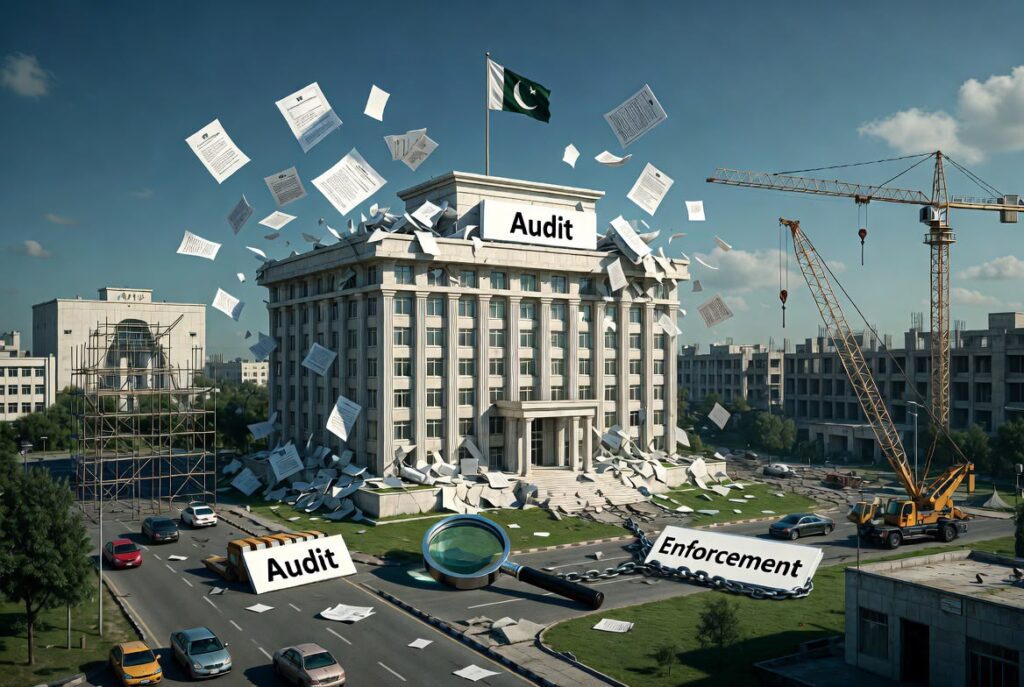
Paper Promises: Why Pakistan’s Provincial Governments Keep Failing to Deliver
A recent speech by Dr. Abdul Basit has reignited a conversation that never really goes away in Pakistan: why do government projects and welfare schemes so consistently fail to produce the outcomes they promise, regardless of which province or which party is in charge? Dr. Basit raised two specific concerns. First, he pointed to an anti-corruption complex reportedly approved in 2022 with an original contract value of around 42 crore rupees, alleging that as of 2026 only two floors had been built and that the revised cost estimate had ballooned to roughly 2.5 billion rupees. Second, he argued that the Benazir Income Support Programme, despite years of disbursement, has not meaningfully reduced poverty, and proposed redirecting resources toward education, industry, and employment generation instead.
It’s worth being upfront about something here: the specific project figures Dr. Basit cited could not be independently verified through public procurement records, audit reports, or news coverage at the time of writing. That doesn’t mean they’re false, but it does mean they should be treated as an allegation rather than an established fact until they’re checked against Sindh Public Procurement Regulatory Authority records, departmental audit reports, or Auditor General findings. What can be verified, however, is the broader pattern he’s gesturing at. Pakistan’s accountability architecture, federal and provincial alike, has a well-documented history of producing exactly the kind of outcome he describes: announced projects, ballooning costs, and very little consequence for anyone involved.
The Pattern Isn’t Province-Specific
It would be easy to read a story like this and assume it’s a Sindh problem, or a particular party’s problem. It isn’t. Whether you look at Khyber Pakhtunkhwa, Punjab, Sindh, or Balochistan, the structural weaknesses are remarkably consistent. The most recent federal Auditor General report for 2025-26 is a useful illustration of just how widespread this is. It found that the Dasu Hydropower Scheme had suffered a 257 percent cost increase, that the Neelum-Jhelum plant has sat offline since May 2024 following tunnel collapses with the resulting inquiries still unfinished, and that the Capital Development Authority had not even prepared annual financial statements for the years under audit. None of this is unique to one province or one government. It’s a description of how public infrastructure spending tends to work across the country.
The same report flagged something specifically relevant to Dr. Basit’s second point: auditors at BISP itself warned of weak data controls leading to ineligible beneficiaries and duplicate payments. This isn’t a new finding. Going back further, the Auditor General’s office told the Public Accounts Committee in January 2023 that 19 billion rupees of BISP funds had been illegally distributed among 143,000 government officials, including over 2,500 ranked at Basic Pay Scale-17 or higher, using the names of spouses and relatives to access funds meant for the poor. The government referred the matter to the Federal Investigation Agency, and reporting from mid-2025 suggests the situation has not meaningfully improved since.

Why “Looks Good on Paper” Rarely Translates to Results
The question you’re really asking, and the one Dr. Basit is gesturing at, is structural rather than personal: why does Pakistan keep producing announcements that don’t survive contact with execution? Part of the answer lies in how thin the connection is between identifying a problem and actually fixing it.
The Auditor General of Pakistan is constitutionally mandated to audit federal and provincial accounts, and its reports are meant to feed into Public Accounts Committees at the national, provincial, and district level. In theory, this is a complete oversight loop. In practice, the IMF’s own Governance and Corruption Diagnostic Assessment found that the AGP produces over 6,000 reports each year, but there is minimal or no follow-up from the Public Accounts Committee and the ministries and divisions, with 75 percent of the 34,000 recommendations made by the Supreme Audit Institution still pending discussion in the PAC. The Fund also noted that audit reports have become so voluminous that they are often counterproductive. The Federal Government Compliance Audit Report for FY2023-24 ran to roughly 4,000 pages, with no system in place for monitoring whether anyone actually responds to or complies with the findings.
This matters for understanding the complex Dr. Basit described, even setting aside the unverified specifics. A 2025-26 federal audit found that only 13 percent of public funds were directed toward genuinely public-good purposes, with 29 percent of supplementary grants issued without parliamentary approval at all. If that is the texture of spending discipline at the federal level, it should not be surprising that individual provincial construction projects stall, get re-tendered, or quietly absorb cost increases several multiples of the original contract.
There’s also a deeper institutional problem that explains why audits rarely translate into consequences. As one recent analysis put it, Pakistan’s audit system continues to function largely as it did under British rule, more focused on counting irregularities than improving systems through corrective action, with the Controller General of Accounts, the Public Accounts Committees, and the Auditor General all operating as separate, under-resourced relics of colonial-era design rather than an integrated accountability system. Compare that to a jurisdiction like New Zealand, where the auditor-general functions as an officer of parliament, departments are legally required to respond to findings, and follow-up reviews are published for public scrutiny. Pakistan has the audit function. What it lacks is the enforcement loop that makes an audit finding mean something.
The Corruption Mechanism Is Predictable, and Largely Unpunished
This is really the crux of your question: why is there no proper system to curb this? The honest answer is that the institutions that exist were not built with enforcement teeth. A detailed account of public sector auditing in Pakistan makes the point bluntly: recommendations are frequently ignored, and there is no robust, legally enforceable mechanism to compel government departments to recover embezzled funds or penalise responsible officials, which creates a culture of impunity where auditing is treated as a paper exercise rather than a consequential process. Even the constitutionally guaranteed independence of the Auditor General’s office is, in practice, compromised, because political pressure can shape the scope, depth, and timing of audits, particularly for high-profile projects under powerful ministries, and even the appointment and tenure of the Auditor General can become politicised.
The IMF’s diagnostic flagged the same structural issue from a different angle, noting that the Auditor General does not report directly to parliament but instead through the Federal Secretariat, the prime minister, and the president, despite constitutional language suggesting independence. An anti-corruption institution that reports through the very executive structures it’s meant to be checking is not positioned to act decisively against politically connected interests, and this dynamic repeats itself in every province’s anti-corruption establishment, not just at the federal level.
What an Education-Focused Alternative Would Actually Require
Dr. Basit’s second argument, that resources should shift from unconditional cash assistance toward education, industry, and employment generation, deserves a fair hearing rather than a reflexive defense or dismissal of BISP. The programme genuinely does some things well. It now reaches close to 58 million people, roughly a quarter of the country’s population, and the World Bank’s evaluation found that its delivery has been transformed by digital identification and biometric verification, allowing real-time verification and faster emergency response, including during the COVID-19 pandemic and the 2022 floods. The Waseela-e-Taleem component already does exactly what Dr. Basit is recommending in miniature, by tying additional payments to school enrollment.
But the World Bank’s own evaluation also validates the core of his critique. It found that BISP’s effect on reducing poverty has diminished over time because the value of the benefit has gradually eroded relative to need, and recommended that the benefit level be raised significantly, to around 15 percent of average household consumption, just to restore its impact. Academic literature reviewing the programme reaches a similar conclusion from a different direction: BISP helps in the short run but does not address the more fundamental structural problems that sustain poverty, such as inadequate education, low wages, and limited freedom of opportunity.
In other words, the choice isn’t really cash transfers versus education spending. The honest version of Dr. Basit’s argument is that unconditional cash assistance without a credible pathway out of the conditions that created the need for it will always look like a programme that “doesn’t work,” even when it is functioning exactly as designed, as an emergency buffer rather than a development strategy. Pairing it with serious investment in education and employment isn’t an alternative to BISP. It’s the missing second half of the same policy.
The Real Diagnosis
What ties Dr. Basit’s two examples together is not corruption in the abstract, but the absence of a functioning feedback loop between spending and outcome, in either direction. Construction contracts inflate without consequence because no institution has the legal power to claw back the money or hold an individual accountable. Welfare spending grows year over year, with BISP’s allocation rising to Rs 716 billion in the 2025-26 federal budget, about a 20 percent increase over the previous year, without a parallel structural investment that would let beneficiaries eventually exit the programme rather than remain dependent on it indefinitely.
This is true in KP, in Punjab, in Sindh, and in Balochistan, under every party that has held power in each. The pattern survives changes in government because it isn’t really a partisan failure. It’s an institutional design failure: audit without enforcement, oversight without consequence, and spending commitments that are easier to announce than to monitor. Until the Auditor General’s office, the Public Accounts Committees, and provincial anti-corruption establishments are restructured with actual enforcement authority and genuine independence from the executive they’re meant to police, speeches like Dr. Basit’s will keep being accurate, and keep changing nothing.
This piece treats Dr. Abdul Basit’s specific factual claims about the anti-corruption complex project as unverified allegations pending confirmation through official procurement and audit records. The broader governance analysis draws on the Auditor General of Pakistan’s published reports, IMF governance diagnostics, World Bank programme evaluations, and contemporary reporting.