Digital Evidence in Criminal Trials: Are Courts Ready for the AI Era?
Introduction
In January 2024, a finance employee at a multinational company transferred approximately HK$25 million after participating in what appeared to be a legitimate video conference with senior executives. Every participant on the call looked authentic, spoke naturally, and behaved exactly as expected. Only later did investigators discover that every executive on the screen had been recreated using artificial intelligence. The meeting itself had never actually taken place.
Incidents like this illustrate a broader reality confronting criminal justice systems around the world. Artificial intelligence is no longer confined to research laboratories or technology companies. It has become a powerful tool capable of creating convincing voices, videos, photographs, and digital identities that can deceive even trained professionals. At the same time, AI is also helping investigators analyse enormous volumes of electronic evidence, identify criminal networks, and detect cyber threats more efficiently than ever before.
This dual nature of artificial intelligence presents courts with an unprecedented challenge. Digital evidence has long been recognised as an essential component of criminal investigations, but judges and lawyers must now determine whether the evidence before them represents an authentic record of events or an artificially generated fabrication. Traditional evidentiary rules were developed when documents, witness testimony, and physical exhibits formed the backbone of criminal proceedings. Today’s legal systems must instead evaluate cloud data, encrypted communications, smartphone records, surveillance footage, blockchain transactions, and AI-generated media.
The question facing modern courts is therefore much larger than whether artificial intelligence can produce convincing fake evidence. The real challenge lies in determining whether existing legal principles are sufficiently adaptable to preserve fairness while embracing technological innovation. Every criminal conviction depends upon the integrity of evidence presented before the court. If confidence in digital evidence begins to erode, the consequences extend far beyond individual cases and threaten public confidence in the justice system itself.
This article examines how digital evidence has evolved, how artificial intelligence is transforming criminal investigations, and whether courts around the world are prepared to address the legal and technological challenges that accompany the AI era.
Understanding Digital Evidence in Criminal Trials
Modern criminal investigations generate enormous amounts of digital information. Every smartphone call, email, online purchase, GPS location, surveillance recording, and social media interaction potentially creates data that may later become evidence in court. Unlike traditional evidence, which often exists in physical form, digital evidence consists of electronically stored information that can be collected, analysed, preserved, and presented during legal proceedings.
Digital evidence includes much more than files stored on a computer. It encompasses information obtained from mobile devices, cloud storage services, internet browsers, wearable fitness devices, vehicle navigation systems, smart home technology, security cameras, banking applications, messaging platforms, and even connected household appliances. As societies become increasingly dependent upon digital technologies, criminal investigations naturally rely more heavily on electronic records.
The importance of digital evidence stems from its ability to reconstruct events with remarkable precision. Location history can establish whether a suspect was present at a crime scene. Metadata embedded within photographs may reveal when and where an image was captured. Financial transactions recorded electronically can trace the movement of criminal proceeds across multiple jurisdictions. Internet search histories may demonstrate planning or intent before an offence occurs.
Yet digital evidence also introduces significant legal complexities. Unlike physical evidence, electronic data can be duplicated instantly, modified remotely, encrypted beyond immediate access, or deleted entirely. Courts must therefore determine not only whether evidence is relevant but also whether it has been preserved in a manner that guarantees its authenticity.
Most legal systems require prosecutors to establish that digital evidence has remained substantially unchanged from the moment it was collected until it is presented in court. This principle, commonly referred to as maintaining the chain of custody, becomes considerably more challenging when dealing with cloud-based systems, distributed servers, and international data transfers.
Authentication has consequently become one of the most important aspects of digital evidence. Before electronic information can influence judicial decision-making, courts must be satisfied that it accurately represents the events it purports to record. This process often requires digital forensic experts capable of explaining complex technical procedures in language that judges and juries can understand.
The Evolution of Digital Evidence
The concept of digital evidence has changed dramatically over the past three decades. During the early years of computer crime investigations, electronic evidence primarily consisted of hard drives, floppy disks, email communications, and simple computer records. Law enforcement agencies developed forensic techniques focused largely on recovering deleted files and examining local storage devices.
The widespread adoption of the internet fundamentally transformed this landscape. Criminal investigations increasingly involved websites, online financial transactions, internet service providers, and electronic communications that frequently crossed national borders. Investigators were no longer examining a single computer but attempting to reconstruct digital activities spanning multiple countries and legal jurisdictions.
The smartphone revolution accelerated this transformation. Modern mobile devices function as cameras, communication platforms, banking tools, navigation systems, and personal diaries simultaneously. A single smartphone may contain years of messages, photographs, biometric data, internet searches, financial records, health information, and precise location history. Consequently, mobile devices often provide investigators with a comprehensive digital timeline of an individual’s activities.
Cloud computing introduced another significant development. Information that was once stored on physical devices now resides on servers distributed across multiple countries. While cloud storage enables users to access information conveniently from anywhere in the world, it also creates jurisdictional challenges for criminal investigations. Obtaining evidence frequently requires cooperation between governments, multinational technology companies, and international law enforcement agencies.
The rapid expansion of social media further increased the significance of digital evidence. Platforms such as Facebook, X, Instagram, TikTok, and LinkedIn have become valuable sources of information during criminal investigations. Public posts, private messages, photographs, livestreams, and user interactions may all provide relevant evidence concerning motive, intent, association, or identity.
Today, artificial intelligence represents the latest stage in this continuing evolution. Unlike previous technological advances that merely generated additional forms of evidence, AI has begun influencing the evidence itself. Machine learning systems can analyse millions of documents within minutes, identify behavioural patterns invisible to human investigators, and assist forensic specialists in processing vast quantities of electronic information. At the same time, generative AI can create fabricated videos, synthetic voices, manipulated photographs, and convincing digital documents that are increasingly difficult to distinguish from authentic evidence.
This transformation requires courts to reconsider long-established assumptions regarding reliability and authenticity. The legal framework governing evidence has historically evolved gradually in response to technological innovation. Artificial intelligence, however, is advancing at a pace that challenges the ability of legislation, judicial practice, and forensic science to adapt.
The next question is therefore unavoidable: if artificial intelligence can create evidence that appears entirely genuine, how can courts confidently distinguish truth from fabrication? That challenge lies at the heart of modern criminal justice and will shape the future of digital evidence in ways that legal systems are only beginning to understand.
Deepfakes and the New Challenge of Criminal Evidence
Perhaps no technological development has unsettled the criminal justice system more than the emergence of deepfakes. Using sophisticated artificial intelligence models, individuals can now generate realistic videos, audio recordings, and photographs that appear authentic but are entirely fabricated. What once required advanced editing skills and significant financial resources can now be accomplished with commercially available AI tools.
The legal implications are profound. Courts have traditionally regarded video and audio recordings as persuasive forms of evidence because they seemingly capture events as they occurred. A surveillance video, a recorded confession, or a voice message has often carried considerable evidentiary weight. Deepfake technology challenges this long-standing assumption by making it possible to manufacture highly convincing evidence that never existed.
Imagine a criminal trial in which prosecutors present a video showing a suspect at the scene of a crime. A decade ago, the authenticity of such footage might rarely have been questioned unless there were obvious signs of manipulation. Today, defence lawyers may legitimately argue that the recording is AI-generated. Conversely, genuine evidence may also be dismissed as fake simply because deepfake technology exists. Legal scholars have described this phenomenon as the “liar’s dividend,” where individuals exploit public awareness of AI manipulation to deny authentic evidence.
This challenge extends beyond criminal defendants. Victims of fraud, identity theft, blackmail, and online harassment increasingly encounter AI-generated material designed to damage reputations or deceive investigators. Deepfake voice recordings have been used to impersonate company executives, family members, and government officials. AI-generated videos have been circulated to influence public opinion, interfere with elections, and facilitate financial fraud.
Courts therefore face two equally difficult responsibilities. They must identify fabricated evidence before it influences judicial decisions while also ensuring that authentic digital evidence is not unfairly rejected due to growing public scepticism.
Several jurisdictions have begun responding to these risks. Some states in the United States have enacted legislation targeting malicious deepfakes, particularly those affecting elections and intimate images. The European Union’s AI Act introduces transparency obligations for certain AI-generated content, while countries including China have adopted regulations requiring the clear identification of synthetic media under specific circumstances. Although these measures represent meaningful progress, they remain fragmented and primarily focus on preventing misuse rather than addressing evidentiary challenges within criminal courts.
Ultimately, the effectiveness of any legal framework depends not only on legislation but also on the technical ability of investigators and forensic experts to detect sophisticated AI manipulation.
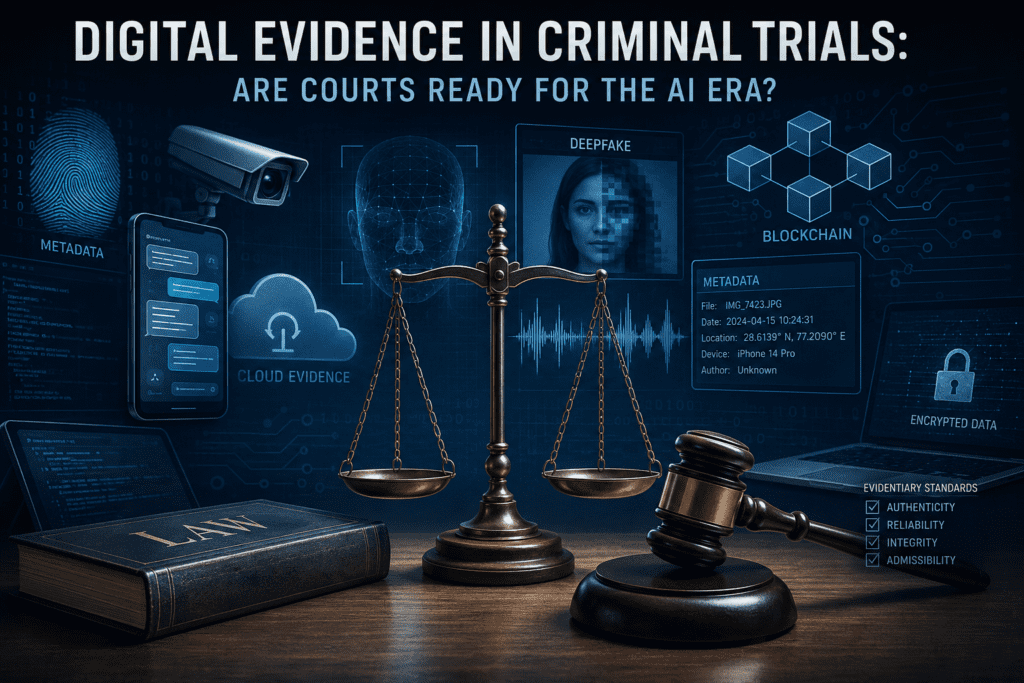
Electronic Evidence in Modern Criminal Investigations
Electronic evidence now plays a central role in almost every major criminal investigation. Whether authorities are investigating organised crime, financial fraud, terrorism, cybercrime, homicide, or corruption, investigators routinely collect electronic information from numerous digital sources.
Smartphones often provide the most comprehensive collection of evidence. They contain communication histories, internet searches, photographs, biometric authentication records, location data, financial transactions, and application activity. Together, these records can reveal an individual’s movements, associations, and decision-making before, during, and after an alleged offence.
Cloud computing has further expanded the scope of electronic evidence. Individuals increasingly store documents, photographs, business records, and personal communications on remote servers rather than local devices. While this offers convenience, it complicates criminal investigations because the relevant data may be distributed across multiple countries. Investigators frequently require cooperation from technology companies that operate under different legal systems, each with its own privacy laws and disclosure requirements.
Encrypted messaging platforms present another significant challenge. Applications offering end-to-end encryption protect user privacy by ensuring that only communicating parties can read exchanged messages. While encryption serves important human rights interests, it also limits investigators’ ability to access communications relevant to criminal investigations.
Governments around the world continue debating whether technology companies should provide lawful access mechanisms for law enforcement agencies. Privacy advocates warn that weakening encryption could expose millions of innocent users to cybersecurity threats, while law enforcement agencies argue that inaccessible encrypted communications create safe havens for criminal organisations. Courts increasingly find themselves balancing these competing interests without universally accepted legal standards.
Deleted electronic evidence presents additional complexities. Contrary to popular belief, deleting a file rarely removes it immediately from digital storage. Digital forensic specialists can often recover deleted information using specialised techniques. However, successful recovery depends upon numerous technical factors, including device usage after deletion, encryption methods, storage architecture, and available forensic tools.
The increasing volume of electronic evidence has also transformed criminal investigations. A single investigation may involve millions of emails, thousands of photographs, countless text messages, extensive surveillance footage, and vast quantities of internet activity. Artificial intelligence is becoming indispensable for organising and analysing these enormous datasets, enabling investigators to identify patterns that would otherwise require months of manual examination.
Despite these technological advantages, AI-assisted analysis raises important legal questions. Defence lawyers may question the accuracy of machine learning algorithms, demand disclosure regarding algorithmic decision-making, or challenge whether automated systems introduced bias during evidence analysis. Courts must therefore evaluate not only the underlying evidence but also the reliability of the technologies used to interpret it.
Metadata: The Hidden Layer of Digital Truth
Behind every digital file exists a collection of hidden information known as metadata. Although invisible during ordinary use, metadata often provides investigators with crucial details concerning the origin, history, and authenticity of electronic evidence.
A digital photograph, for example, may contain information identifying the exact date and time it was captured, the GPS coordinates where it was taken, the camera model used, software modifications, and even technical details regarding image processing. Similarly, electronic documents frequently record creation dates, editing history, author information, and version changes.
For criminal investigators, metadata serves as an important verification tool. It can confirm whether an image was captured at the location claimed by a witness, determine whether a document has been modified after its creation, or establish the sequence of events leading to an alleged offence.
Metadata has proven especially valuable in cybercrime investigations, financial fraud cases, and digital communication disputes. Email metadata can identify originating servers, transmission routes, timestamps, and recipient information. Mobile phone metadata may reveal communication patterns between suspects even when message contents remain inaccessible due to encryption.
However, metadata should not be viewed as infallible. Sophisticated cybercriminals possess tools capable of modifying or removing metadata entirely. Certain social media platforms automatically strip metadata from uploaded images, while privacy-focused applications intentionally minimise stored metadata to protect user anonymity.
Consequently, digital forensic experts rarely rely upon metadata alone. Instead, they compare metadata with other evidence, including witness testimony, network logs, surveillance footage, telecommunications records, and device examination results. This multidisciplinary approach helps establish a more reliable evidentiary picture.
Courts increasingly recognise the importance of expert testimony in explaining metadata. Judges and juries generally lack technical expertise concerning digital file structures, making forensic specialists essential in translating complex technical findings into understandable legal evidence. The credibility of these experts often determines whether metadata strengthens or weakens the prosecution’s case.
As artificial intelligence becomes more capable of generating realistic digital content, metadata will likely assume even greater importance. Future forensic techniques may rely upon sophisticated combinations of metadata analysis, AI detection systems, cryptographic verification, and behavioural analysis to distinguish authentic evidence from synthetic creations.
Blockchain and the Future of Evidence Integrity
Among emerging technologies, blockchain has attracted growing attention as a potential solution to some of the authenticity challenges surrounding digital evidence. Originally developed to support cryptocurrencies, blockchain functions as a decentralised ledger that records transactions in a manner designed to resist unauthorised alteration.
Its defining characteristic is immutability. Once information is securely recorded on a blockchain, altering that record without detection becomes extremely difficult. This characteristic has prompted legal scholars and forensic experts to consider whether blockchain could strengthen the chain of custody for digital evidence.
Maintaining an unbroken chain of custody remains one of the most important requirements in criminal proceedings. Investigators must demonstrate exactly who collected evidence, when it was collected, how it was stored, and whether it remained unchanged before reaching the courtroom. Any unexplained gap may undermine confidence in the evidence and reduce its evidentiary value.
Blockchain systems offer one possible method of documenting every stage of this process. Each transfer, examination, or storage event could be permanently recorded with precise timestamps, creating an auditable history that is difficult to manipulate retrospectively. Such systems could increase transparency while reducing opportunities for accidental or intentional evidence tampering.
Several pilot projects have already explored blockchain-based evidence management, particularly within digital forensics and cybersecurity investigations. Researchers suggest that combining blockchain with cryptographic hashing could enable investigators to demonstrate mathematically that electronic evidence has not changed since collection.
Nevertheless, blockchain is not a universal solution. Recording inaccurate information on an immutable ledger does not make that information accurate. If investigators initially collect compromised or fabricated evidence, blockchain merely preserves that error. Furthermore, implementing blockchain-based evidence systems requires substantial technological investment, specialised expertise, and interoperability between law enforcement agencies operating under different legal systems.
Questions also remain regarding judicial acceptance. Courts would need confidence not only in blockchain technology itself but also in the procedures governing its implementation. Judges must understand how blockchain records are created, maintained, verified, and challenged before they can confidently rely upon them during criminal proceedings.
Blockchain therefore represents an important technological development rather than a complete legal answer. It may strengthen evidentiary integrity, but it cannot replace careful forensic investigation, expert analysis, judicial scrutiny, or established principles of procedural fairness. Together with artificial intelligence, however, it illustrates how rapidly technological innovation is reshaping the landscape of criminal evidence and compelling legal systems to reconsider traditional approaches to proof.
Evidentiary Standards in the Age of Artificial Intelligence
Every legal system establishes rules governing what evidence may be admitted in court and how its reliability should be assessed. These evidentiary standards are designed to ensure that criminal convictions are based on trustworthy information rather than speculation or unreliable material. As digital evidence has become increasingly central to criminal prosecutions, courts have had to adapt long-established legal principles to technologies that did not exist when many evidentiary rules were first developed.
In the United States, digital evidence must satisfy the requirements of the Federal Rules of Evidence, particularly those relating to relevance, authenticity, hearsay, and expert testimony. Rule 901 requires the party presenting evidence to produce sufficient proof that an item is what it claims to be. In the context of AI-generated content, this requirement has become increasingly significant because visual realism alone can no longer establish authenticity. Prosecutors must often rely on forensic experts, metadata analysis, and corroborating evidence to demonstrate that digital material has not been manipulated.
The United Kingdom follows a similar approach under the Police and Criminal Evidence Act 1984 and the Criminal Procedure Rules. Courts focus on the integrity of the evidence collection process, the reliability of forensic methods, and the qualifications of expert witnesses. Judges possess considerable discretion when determining whether electronic evidence should be admitted, particularly where questions arise regarding authenticity or procedural fairness.
Across the European Union, member states operate under different procedural systems, yet they increasingly share common concerns regarding digital evidence. The European Union has introduced legislative initiatives to facilitate cross-border access to electronic evidence while maintaining strong safeguards for privacy and fundamental rights. The proposed e-Evidence framework reflects an effort to streamline cooperation between law enforcement authorities and technology companies operating across multiple jurisdictions.
Canada has gradually modernised its evidentiary framework to accommodate digital information while preserving judicial oversight. Canadian courts frequently require evidence demonstrating that electronic records were generated and maintained through reliable systems. Australia has likewise incorporated provisions recognising electronic records while emphasising authenticity and the proper functioning of electronic systems.
India presents an interesting example of legislative adaptation. The Indian Evidence Act was amended through the Information Technology Act, introducing provisions governing electronic records. Section 65B became particularly important because it established certification requirements for the admissibility of electronic evidence. Although judicial interpretation has evolved over time, the provision illustrates how legislatures have attempted to address technological developments through statutory reform.
Singapore has emerged as one of the more technologically progressive jurisdictions. Its Evidence Act recognises electronic records while encouraging the responsible use of technology in judicial proceedings. Singapore’s broader digital governance strategy demonstrates how legislative reform, judicial education, and technological investment can complement one another.
Despite differences in legal systems, a common theme emerges. Courts worldwide increasingly recognise that traditional evidentiary principles remain relevant, but their practical application has become considerably more complex in the AI era. Authenticity, reliability, and procedural fairness continue to guide judicial decision making, yet determining whether those standards have been satisfied now requires far greater technical expertise.
International Cooperation and the Legal Framework for Digital Evidence
Digital evidence rarely respects national borders. A cyberattack launched from one country may target victims in another while relying on servers located across several continents. Social media accounts used in criminal investigations may be operated from multiple jurisdictions, and cloud storage providers often distribute user data globally to improve efficiency and security.
These realities have transformed international cooperation into an essential component of modern criminal investigations.
One of the most influential international agreements in this field is the Budapest Convention on Cybercrime. Adopted by the Council of Europe, the Convention provides a framework for cooperation among participating states in investigating cybercrime and obtaining electronic evidence. It establishes procedures for preserving stored computer data, accessing electronic information, and facilitating mutual legal assistance between countries.
The Convention has become particularly significant because many cyber investigations require rapid preservation of digital evidence before it is altered or deleted. Unlike physical evidence, electronic information can disappear within minutes. International cooperation therefore depends not only on legal agreements but also on speed and technical capability.
Mutual Legal Assistance Treaties, commonly referred to as MLATs, have traditionally served as the primary mechanism through which countries request evidence located abroad. While MLATs remain important, they have often been criticised for being too slow to address modern digital investigations. Criminal investigators may wait months or even years before receiving requested electronic records, by which time evidence may have become unavailable or significantly less valuable.
Recognising these challenges, several jurisdictions have introduced alternative mechanisms. The United States enacted the CLOUD Act, allowing certain foreign governments to request electronic data directly from American technology companies under qualifying agreements. The European Union has similarly pursued legislative reforms designed to improve access to cross-border electronic evidence while maintaining judicial oversight and privacy protections.
International organisations such as INTERPOL and Europol have also expanded their role in supporting digital investigations. These organisations facilitate intelligence sharing, coordinate multinational operations, and provide technical expertise in combating cybercrime, online fraud, child exploitation, ransomware attacks, and other offences involving electronic evidence.
Nevertheless, international cooperation remains far from seamless. Countries differ significantly regarding privacy rights, surveillance powers, evidentiary requirements, and constitutional protections. A form of evidence lawfully obtained in one jurisdiction may be considered inadmissible in another. These legal differences create uncertainty for prosecutors, defence lawyers, and judges attempting to navigate increasingly global criminal investigations.
The challenge becomes even greater when artificial intelligence enters the equation. If AI-generated evidence is created in one country, distributed through servers in another, and introduced during proceedings elsewhere, determining which legal standards apply may prove exceptionally difficult.
Landmark Judicial Decisions Shaping Digital Evidence
Judicial decisions have played a crucial role in defining how courts approach digital evidence. Although artificial intelligence remains a relatively new issue, earlier cases concerning electronic records, privacy, and forensic reliability continue to influence contemporary legal reasoning.
In the United States, Daubert v. Merrell Dow Pharmaceuticals, Inc. established principles governing the admissibility of expert scientific evidence. While the case did not concern digital evidence directly, its emphasis on reliability, testing, peer review, and acceptance within the relevant scientific community has become highly relevant to digital forensic testimony and AI detection technologies. Courts increasingly rely on these principles when evaluating expert opinions concerning electronic evidence.
Another significant decision is Riley v. California (2014), in which the United States Supreme Court recognised the unique privacy interests associated with smartphones. The Court held that law enforcement generally requires a warrant before searching the contents of a mobile phone seized during an arrest. The judgment acknowledged that modern smartphones contain vast quantities of personal information far exceeding what could traditionally be found in physical searches.
Within Europe, the European Court of Human Rights has repeatedly emphasised the importance of balancing criminal investigations with the right to privacy protected under Article 8 of the European Convention on Human Rights. Decisions concerning surveillance, interception of communications, and data retention continue shaping how electronic evidence is collected and used.
Indian courts have also contributed significantly to the development of electronic evidence law. In Anvar P.V. v. P.K. Basheer, the Supreme Court clarified the importance of statutory requirements governing electronic records and reinforced the necessity of complying with procedural safeguards before such evidence could be admitted. Later decisions refined aspects of this approach while recognising the practical realities of digital investigations.
Although courts have not yet developed an extensive body of jurisprudence specifically addressing AI-generated evidence, several recent cases involving deepfakes, manipulated media, and algorithmic decision making suggest that judges are becoming increasingly aware of the challenges posed by artificial intelligence. Future judicial decisions will likely establish new evidentiary standards addressing AI authentication, forensic verification, and expert testimony.
These evolving precedents demonstrate that judicial adaptation often occurs incrementally. Courts rarely abandon established legal principles. Instead, they reinterpret existing doctrines to accommodate new technologies while preserving fundamental procedural safeguards.
Are Courts Truly Prepared for the AI Era?
Despite significant legal developments, many experts argue that courts remain only partially prepared for the rapid transformation occurring within digital evidence.
The first challenge involves technological complexity. Judges, lawyers, and jurors are legal professionals rather than computer scientists. Understanding artificial intelligence, machine learning algorithms, cryptographic verification, metadata analysis, or blockchain systems often requires specialised knowledge that lies beyond traditional legal education. This knowledge gap increases reliance on expert witnesses whose testimony may itself become the subject of dispute.
A second concern involves the speed of technological innovation. Artificial intelligence evolves far more rapidly than legislation. By the time lawmakers enact new rules addressing one technological capability, developers may already have introduced more sophisticated systems capable of creating entirely new evidentiary challenges. This legislative lag places courts in the difficult position of applying existing legal principles to technologies that legislators never anticipated.
The growing accessibility of AI tools presents another obstacle. Previously, sophisticated digital manipulation required considerable expertise. Today, commercially available applications enable ordinary users to generate realistic synthetic voices, edited photographs, and convincing videos with minimal technical knowledge. As barriers to misuse decline, courts can expect a corresponding increase in disputes concerning digital authenticity.
Resource disparities also affect judicial preparedness. Wealthier jurisdictions often possess advanced forensic laboratories, specialised investigators, and experienced prosecutors familiar with digital evidence. Developing countries may lack comparable technological resources, making it more difficult to authenticate complex electronic evidence or detect sophisticated AI manipulation.
Finally, public perception presents an often overlooked challenge. As awareness of deepfakes grows, confidence in digital evidence may decline generally. Genuine evidence risks being questioned simply because convincing forgeries are now technologically possible. Courts must therefore preserve public trust while adapting to a rapidly changing technological environment.
These challenges do not suggest that courts are incapable of administering justice in the AI era. Rather, they demonstrate that legal systems must continue evolving through legislative reform, judicial education, technological investment, and international cooperation if they are to maintain confidence in criminal proceedings.
Comparative Analysis: Which Legal Systems Are Best Prepared?
Although every jurisdiction is confronting the challenges posed by artificial intelligence and digital evidence, their responses differ significantly. Some have focused on strengthening privacy protections, while others have prioritised law enforcement capabilities or technological innovation. No country has yet developed a complete legal framework capable of addressing every issue associated with AI-generated evidence, but several jurisdictions have taken meaningful steps toward modernising their criminal justice systems.
The European Union has emerged as one of the most proactive regulators of artificial intelligence. Through the AI Act and complementary digital legislation, the EU has adopted a risk-based approach that seeks to regulate AI without discouraging innovation. The AI Act introduces obligations for developers and deployers of high-risk AI systems, promotes transparency in relation to AI-generated content, and establishes governance mechanisms intended to reduce harmful uses of artificial intelligence. Although the legislation does not specifically resolve every evidentiary issue arising in criminal trials, it creates a regulatory environment that encourages accountability and traceability.
The United States has adopted a more fragmented approach. Rather than relying on a single federal AI law, regulation has developed through executive action, agency guidance, state legislation, and judicial interpretation. American courts possess considerable experience dealing with digital evidence, supported by well-established forensic practices and extensive case law. However, the absence of comprehensive national AI legislation means that legal responses often vary between jurisdictions. This flexibility allows innovation but may also create inconsistency in evidentiary standards.
The United Kingdom continues to favour a principles-based regulatory model. Instead of introducing a dedicated AI statute, regulators have encouraged existing institutions to oversee artificial intelligence within their respective sectors. This approach allows greater adaptability but may require additional legislative clarification as AI-generated evidence becomes increasingly common in criminal proceedings.
Singapore is widely regarded as one of the most technologically advanced legal systems in Asia. The country has invested heavily in digital governance, judicial modernisation, and cybersecurity while promoting responsible AI development. Courts benefit from strong institutional support and a legal framework that generally embraces technological innovation without overlooking procedural safeguards.
Canada and Australia occupy positions somewhere between the American and European models. Both countries have modernised evidentiary rules relating to electronic records while continuing to emphasise judicial oversight, procedural fairness, and privacy rights. Their legal systems demonstrate a willingness to adapt incrementally rather than through sweeping legislative reform.
India faces a unique combination of opportunities and challenges. As one of the world’s largest digital economies, the country generates enormous volumes of electronic evidence. Indian courts have developed significant jurisprudence concerning electronic records, yet practical challenges remain regarding forensic capacity, technological infrastructure, and case backlogs. Ongoing legal reforms indicate growing recognition of the need to strengthen digital evidence procedures as artificial intelligence becomes increasingly prevalent.
China has pursued perhaps the most comprehensive regulatory approach to artificial intelligence among major economies. Regulations governing generative AI, recommendation algorithms, and synthetic media demonstrate a willingness to intervene early in technological development. At the same time, China’s broader regulatory philosophy differs substantially from many Western democracies, particularly regarding government oversight and data governance. Consequently, while certain regulatory measures may strengthen evidence authentication, they also raise important questions concerning privacy and state surveillance.
Taken together, these approaches reveal that there is no universally accepted model for regulating AI-generated evidence. Each jurisdiction reflects its own constitutional values, legal traditions, and policy priorities. Nevertheless, several common themes emerge. Countries investing in digital forensic capabilities, judicial education, international cooperation, and clear regulatory frameworks appear better positioned to address the evidentiary challenges created by artificial intelligence.
Ethical Questions That Law Alone Cannot Answer
Even the most carefully drafted legislation cannot resolve every challenge presented by artificial intelligence. Many of the most difficult questions surrounding digital evidence are ethical rather than purely legal.
One major concern involves algorithmic bias. Artificial intelligence systems learn from data, and the quality of their decisions depends heavily upon the information used during training. If historical data reflects existing biases relating to race, gender, socioeconomic status, or geography, AI systems may unintentionally reproduce those biases. When such systems assist criminal investigations, they risk reinforcing existing inequalities within the justice system.
Predictive policing illustrates this dilemma. Several law enforcement agencies have experimented with AI systems designed to predict where crimes are likely to occur or identify individuals considered at higher risk of offending. Supporters argue that these technologies improve resource allocation and crime prevention. Critics contend that they may disproportionately target already over-policed communities, creating a cycle in which biased data produces biased outcomes.
Transparency presents another ethical challenge. Many sophisticated AI models operate as “black boxes,” meaning even their developers cannot fully explain how specific outputs are generated. This lack of explainability conflicts with fundamental principles of criminal justice. Defendants have the right to understand and challenge the evidence presented against them. If prosecutors rely upon AI-generated conclusions that cannot be meaningfully explained, courts may struggle to protect due process.
Privacy also remains a central concern. Modern investigations increasingly rely on data generated through smartphones, wearable devices, online platforms, facial recognition systems, and internet-connected technologies. While these sources may assist criminal investigations, they also create unprecedented opportunities for government surveillance. Democracies must therefore balance public safety with the protection of individual rights.
There is also the ethical issue of overreliance on technology. Artificial intelligence should assist human decision making rather than replace it. Judges possess legal experience, contextual understanding, and moral reasoning that machines cannot replicate. Criminal liability often depends upon subtle assessments of credibility, intent, proportionality, and fairness that extend beyond algorithmic analysis.
Finally, public confidence in the justice system depends upon trust. If citizens begin believing that courts cannot distinguish authentic evidence from fabricated material, confidence in judicial outcomes may gradually erode. Preserving that trust requires more than technological solutions. It requires transparent procedures, independent forensic expertise, robust judicial oversight, and a continued commitment to the rule of law.
The Future of Criminal Justice in the AI Era
Artificial intelligence will undoubtedly become a permanent feature of criminal justice systems. The relevant question is no longer whether courts should engage with AI but how they can do so responsibly.
Future investigations will likely involve AI-assisted forensic analysis capable of identifying manipulation within digital images, detecting inconsistencies in synthetic audio, and verifying the authenticity of electronic records more efficiently than current methods. Machine learning systems may assist investigators in identifying complex financial crimes, analysing cyberattacks, and processing enormous volumes of digital evidence that would otherwise overwhelm human investigators.
Blockchain technology may also play a greater role in preserving the integrity of evidence by creating tamper-resistant records documenting every stage of the chain of custody. While blockchain cannot guarantee that evidence is truthful, it can strengthen confidence that evidence has not been altered after collection.
Judicial education will become increasingly important. Judges, prosecutors, defence lawyers, and forensic experts must continually update their understanding of emerging technologies if they are to apply evidentiary rules effectively. Legal education institutions should similarly integrate artificial intelligence, cybersecurity, digital forensics, and technology law into mainstream legal curricula.
Legislatures will also need to modernise evidentiary frameworks. Rather than attempting to regulate individual technologies, lawmakers should develop technology-neutral principles capable of adapting to future innovations. Flexibility will prove essential because artificial intelligence is evolving far more rapidly than statutory reform.
International cooperation must likewise deepen. Cybercrime, AI-generated fraud, ransomware attacks, and digital evidence frequently cross national borders. Strengthening mechanisms for evidence sharing, forensic cooperation, and harmonised legal standards will become increasingly necessary if criminal investigations are to remain effective.
Above all, legal systems must recognise that artificial intelligence should enhance justice rather than compromise it. Technology can improve efficiency, accuracy, and investigative capability, but it cannot replace fundamental legal values such as fairness, transparency, accountability, and respect for human rights. Those principles must continue guiding the development of evidentiary law regardless of how sophisticated artificial intelligence becomes.
Conclusion
Digital evidence has transformed criminal justice more profoundly than almost any previous technological development. Smartphones, cloud computing, social media, blockchain, and artificial intelligence have expanded the range of information available to investigators while simultaneously creating new legal and ethical challenges. The rise of deepfakes and AI-generated content has further complicated the evidentiary landscape by undermining assumptions about authenticity that courts relied upon for decades.
Although existing evidentiary principles remain relevant, they are increasingly being tested by technologies capable of producing convincing synthetic evidence and analysing vast quantities of digital information. Courts have responded through evolving case law, legislative reform, and greater reliance on digital forensic expertise, yet significant gaps remain. Differences between national legal systems, limited technical expertise, resource constraints, and rapidly advancing AI capabilities continue to challenge the administration of justice.
The future of criminal trials will depend upon the ability of legal systems to combine technological innovation with enduring legal principles. Artificial intelligence should not be viewed solely as a threat to evidentiary reliability. When used responsibly, it also offers powerful tools for detecting fraud, improving forensic investigations, and strengthening judicial decision making.
Courts may not yet be fully prepared for the AI era, but they are no longer standing at its threshold. They are already operating within it. The challenge now is to ensure that legal institutions evolve quickly enough to preserve public confidence, protect fundamental rights, and maintain the integrity of criminal justice in an increasingly digital world.
Frequently Asked Questions
What is digital evidence in criminal law?
Digital evidence refers to electronically stored or transmitted information, such as emails, text messages, CCTV footage, smartphone data, cloud records, and social media activity, that can be used during criminal investigations and court proceedings.
Can deepfakes be used as evidence in court?
Deepfakes may be presented during legal proceedings, but courts will require rigorous authentication and forensic analysis before determining whether such material is genuine or fabricated.
Why is metadata important in criminal investigations?
Metadata provides information about when, where, and how digital files were created or modified. It often helps investigators verify the authenticity of electronic evidence.
How does blockchain strengthen digital evidence?
Blockchain can create secure, tamper-resistant records documenting the chain of custody, making it easier to demonstrate that evidence has not been altered after collection.
Which international treaty governs cybercrime investigations?
The Budapest Convention on Cybercrime remains the leading international agreement supporting cooperation in cybercrime investigations and the collection of electronic evidence.
Can artificial intelligence replace judges in criminal trials?
No. AI can assist with analysing evidence and improving efficiency, but judicial decisions require legal reasoning, ethical judgment, and human oversight.
What is the biggest challenge courts face with AI-generated evidence?
The greatest challenge is verifying authenticity while ensuring that genuine evidence is not wrongly dismissed and fabricated evidence is not accepted.
Why do countries regulate digital evidence differently?
Legal systems reflect different constitutional traditions, privacy protections, criminal procedures, and policy priorities, leading to varying approaches to digital evidence and AI regulation.