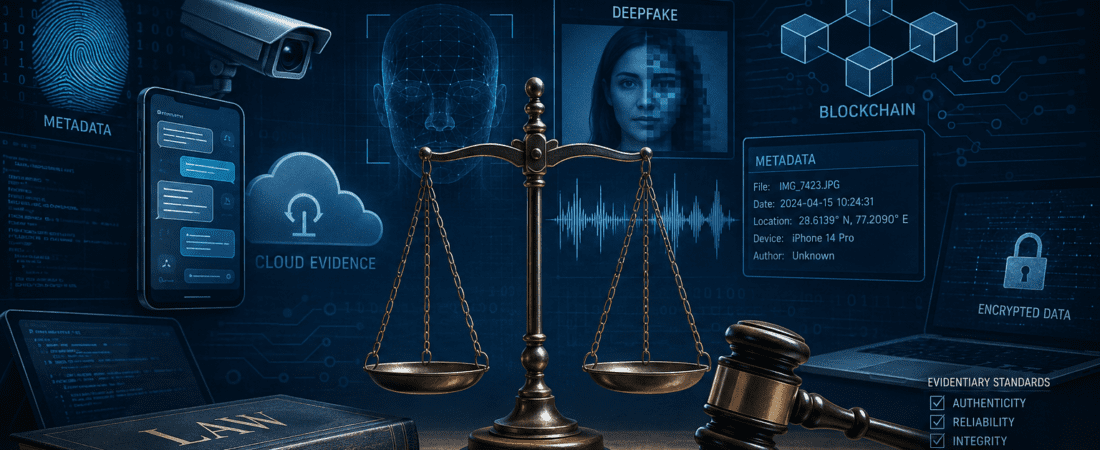
Artificial intelligence has moved from being a specialized tool for data scientists to a common force that is reshaping the legal landscape across the globe. In the world of criminal justice, using AI is not just a simple tech upgrade. It is a major shift that challenges evidentiary principles that have existed for centuries. As police and law enforcement rely more on algorithmic tools for surveillance and forensic analysis, the courts face a tough question: Are they truly ready for this era? This analysis looks at the challenges AI poses to our constitutional rights and asks if our current legal rules are enough to protect people in a world dominated by digital tech.
I. The New Frontier: Defining AI-Generated Evidence
To understand the challenge, we have to see the difference between traditional digital evidence and evidence created by AI. Traditional evidence usually involves static data, like a timestamped email or a GPS log. AI evidence is different because it is dynamic and based on probability. This includes things like facial recognition results, predictive policing models, and “deepfakes” created by generative AI. Because AI is probabilistic, it does not offer 100% certainty. Instead, it gives a mathematical likelihood. This shift from evidence based on simple facts to evidence based on probability means we need to rethink how juries understand technical testimony.
A big problem here is what experts call the “Black Box” issue. Most AI systems work through complex networks where the logic used to get a result is hidden. In a criminal trial, where someone’s freedom is on the line, this lack of transparency clashes with the right to due process. If the prosecutor, the judge, and the defense cannot explain exactly why an AI reached a certain conclusion, we have to ask if that evidence really meets the standard of being beyond a reasonable doubt.
II. The Authentication Crisis: Deepfakes and Rule 901
Under Federal Rule of Evidence 901, evidence must be authenticated by showing it is actually what it claims to be. For a long time, this was a fairly easy requirement to meet. But generative AI has changed that by making digital manipulation much easier. Deepfake audio and video can be made so perfectly that even traditional forensic methods fail to catch them. This leads to something called the “liar’s dividend.” This happens when the mere existence of deepfakes allows people to claim that real, incriminating evidence was actually faked.
Courts need to move past a basic check for authenticity and start using a more rigorous, multi-layered verification process. This might mean that AI forensic experts will need to testify in almost every case that involves digital media. Also, the burden of proof for authenticity might need to change if the defense can show a plausible theory that the digital files were manipulated. Without these updates, the honesty of the judicial record is at risk of being ruined by synthetic media.
III. Algorithmic Bias and the Sixth Amendment
The Sixth Amendment gives a defendant the right to confront the witnesses against them. But how do you cross-examine an algorithm? When a facial recognition match is used as the main evidence of guilt, the “witness” is really just a set of private code. Companies often hide their algorithms behind “trade secret” laws, which stops defense lawyers from checking the code for bias or mistakes. This creates a situation where the defense is at a major disadvantage, which goes against the idea of fairness in criminal trials.
Also, AI is only as fair as the data used to train it. If an algorithm is trained on biased data, it will produce biased results. This cycle can make systemic bias part of the court system under the cover of being “objective.” Without full transparency and the right to check these systems, the presumption of innocence is weakened. The defendant is forced to fight a technological foe that is both invisible and potentially biased.
IV. Predictive Policing and the Fourth Amendment
Predictive policing tools use AI to try and guess where crimes will happen and who will commit them. This raises serious concerns about the Fourth Amendment and “reasonable suspicion.” Can a guess made by an algorithm be enough to justify a stop-and-frisk or a search warrant? If the courts start accepting AI predictions as a reason for probable cause, we might enter an era where constitutional protections are ignored in favor of math. We need to re-evaluate how much weight a “hunch” from an algorithm should have when there is no actual suspicious behavior to see.
V. The Fourteenth Amendment: Due Process in the Digital Age
The Fourteenth Amendment ensures that the state cannot take away a person’s life, liberty, or property without due process of law. When it comes to AI, due process means that the evidence used in court must be reliable and easy to explain. When courts allow evidence from private algorithms without letting the defense challenge how they work, they are basically giving judicial power to software companies. This “privatization of justice” is a threat to the heart of our legal system.
VI. International Perspectives: A Comparative Analysis
While the United States looks at these issues through the Constitution, other countries are trying different things. For example, the European Union’s AI Act calls certain uses of AI by police “high-risk” and requires strict oversight. By looking at these international rules, we can find better ways to balance new technology with the protection of human rights. Because technology is global, we can’t just ignore what the rest of the world is doing.
VII. Conclusion: The Path Toward a Tech-Literate Judiciary
The legal system is at a turning point. To keep things fair in the age of AI, we need to make some big changes. First, we need mandatory transparency for algorithms so that trade secrets don’t stop a defendant from checking the evidence. Second, we need better education for judges so they understand how AI works and the risks of bias. Finally, we need to update the rules of evidence to deal with the unique problems of deepfakes and “black box” systems.
The AI era is already here and it is moving much faster than our laws. Our courts have to adapt their ways and their thinking. If they don’t, they risk becoming outdated in a world where it is getting harder to find the truth and even harder to find justice. Keeping the rule of law alive depends on our ability to hold technology to the same standards of fairness that we expect from people.
Originally published on TheLegalLens.