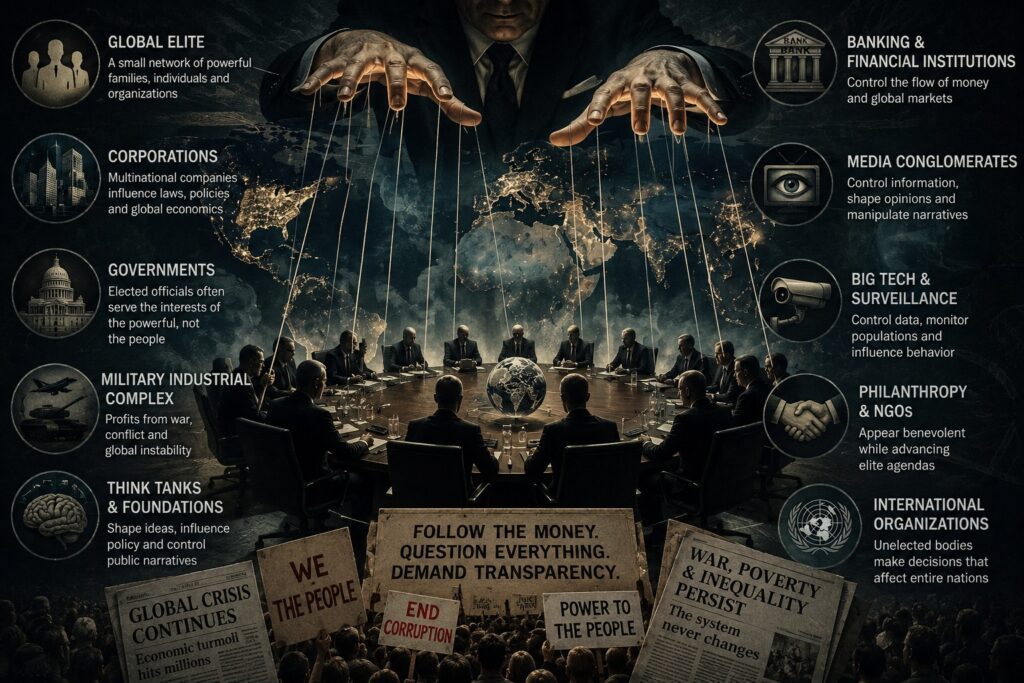
Who Really Rules the World?
Deep Pockets, Lobbyists, Corporate Power, and the Architecture of Global Influence
Ask most people who governs a country and they will point to a parliament, a president, or a prime minister. Ask a lobbyist in Washington or Brussels the same question and you will get a different answer, usually a quieter one, about which committee chair takes their calls and which regulator used to work for the industry they now oversee. Both answers are true, and the gap between them is where this investigation lives.
Formal power sits in constitutions, elections, and courts. Real influence often sits somewhere else, in campaign finance filings, lobbying registries, boardrooms, and the revolving door between government service and private employment. Understanding where one ends and the other begins matters because democratic legitimacy depends on the idea that citizens, not the highest bidder, set the rules. When that idea breaks down even partially, the consequences show up in tax codes written around loopholes, health regulations shaped by the companies they regulate, and elections financed by donors who expect something back.
This piece does not claim that a secret cabal runs the planet. That framing collapses the moment you look closely at how governments, markets, and institutions actually interact, because the picture is far messier and, in some ways, more troubling than a conspiracy would be. It is not a hidden hand. It is a visible, documented, legally structured system in which money buys access, access shapes agendas, and agendas become law.
The Many Faces of Power
Political scientists have long distinguished between different forms of power, and the distinction is useful here. There is coercive power, the kind states hold through police and armies. There is economic power, the kind that comes from controlling capital, supply chains, or employment. There is institutional power, embedded in courts, central banks, and regulatory bodies.
There is also a newer category that scholars like Joseph Nye at Harvard have written about extensively: soft power, the ability to shape preferences through culture, narrative, and platforms rather than force. Related to it is what network theorists call agenda-setting power, the capacity to determine which issues even reach public debate in the first place, regardless of who eventually wins that debate.
What makes the current moment distinctive is how these forms of power increasingly reinforce each other through a single mechanism: organized, well-funded advocacy. A pharmaceutical company does not need an army to shape drug pricing policy. It needs lobbyists, campaign contributions, friendly think tank research, and a favorable media narrative, deployed together and sustained over years. That combination is what modern power actually looks like.
A Brief History of Power: From Rome to the Algorithm
None of this is new. What has changed over roughly two thousand years is the scale, the instruments, and the speed at which influence travels.
In the late Roman Republic, political life ran on a formal system of patronage. Wealthy patricians maintained networks of clients who owed them political loyalty in exchange for protection, favors, and money, a structure historians still use as shorthand for any system where informal obligation substitutes for accountable governance. The Senate itself was, in practice, an assembly of the wealthiest landowning families, and provincial governorships were routinely used to extract fortunes that were then spent buying political support back home. Julius Caesar’s own rise depended on debts financed by allies who expected a return.
The early modern period produced something new: the chartered corporation with quasi-sovereign power. The English East India Company, founded in 1600, began as a trading monopoly and ended up ruling large parts of the Indian subcontinent, maintaining its own army, minting currency, and negotiating treaties, all under a royal charter that blurred the line between private enterprise and the state almost entirely. Its eventual collapse into corruption and financial crisis, culminating in a 1773 bailout by the British Parliament, is one of history’s earliest documented cases of a private company becoming too large and too entangled with government to be allowed to fail, a pattern that would echo strikingly in 2008.
The Industrial Revolution shifted the terrain again, from land and trade monopolies to capital and manufacturing. By the late nineteenth century, the United States had entered what Mark Twain sardonically called the Gilded Age, a period defined by the concentration of enormous fortunes in the hands of a small number of industrialists, John D. Rockefeller in oil, Andrew Carnegie in steel, J.P. Morgan in finance, who built vertically integrated empires and used their wealth to buy legislative influence with little regulatory constraint. Standard Oil alone controlled roughly ninety percent of American oil refining by the 1880s before antitrust action eventually broke it apart.
That antitrust action was itself a product of the Progressive Era, the reform movement that spanned roughly 1890 to 1920 and produced the Sherman Antitrust Act of 1890, the Federal Reserve Act of 1913, and a wave of muckraking journalism that made corporate abuse a matter of public record rather than private rumor. Theodore Roosevelt’s trust-busting presidency remains the clearest historical precedent for the idea that concentrated corporate power requires an equally deliberate governmental counterweight, a lesson each subsequent generation seems to need to relearn.
The period after the Second World War rebuilt the architecture of global power almost from scratch. The 1944 Bretton Woods conference created the International Monetary Fund and the World Bank, institutions explicitly designed to prevent the kind of economic chaos that had helped produce the war in the first place. For roughly three decades, this system coexisted with a broad political consensus, in the United States and much of Western Europe, favoring strong labor protections, progressive taxation, and active industrial policy.
That consensus broke down in the late 1970s and 1980s under what became known as the neoliberal turn, associated most closely with Margaret Thatcher in Britain and Ronald Reagan in the United States. Both leaders pursued aggressive deregulation, privatization of state industries, and tax cuts favoring capital over labor, arguments that were championed and operationalized by a growing network of free-market think tanks. The same logic, exported through IMF and World Bank lending conditions, reshaped economic policy across much of the developing world through the 1980s and 1990s, a period whose consequences are still debated by economists today.
The final major shift is the one still underway: digital capitalism. Where twentieth-century power depended on controlling physical infrastructure, oil pipelines, rail networks, factories, twenty-first-century power increasingly depends on controlling data, attention, and computational capacity. A handful of technology platforms now mediate how billions of people get information, form opinions, and transact, a concentration of influence over communication itself that has no clean historical precedent, though the East India Company’s fusion of commercial and governing power is probably the closest analogy available.
Money and Political Influence: A Global Comparison
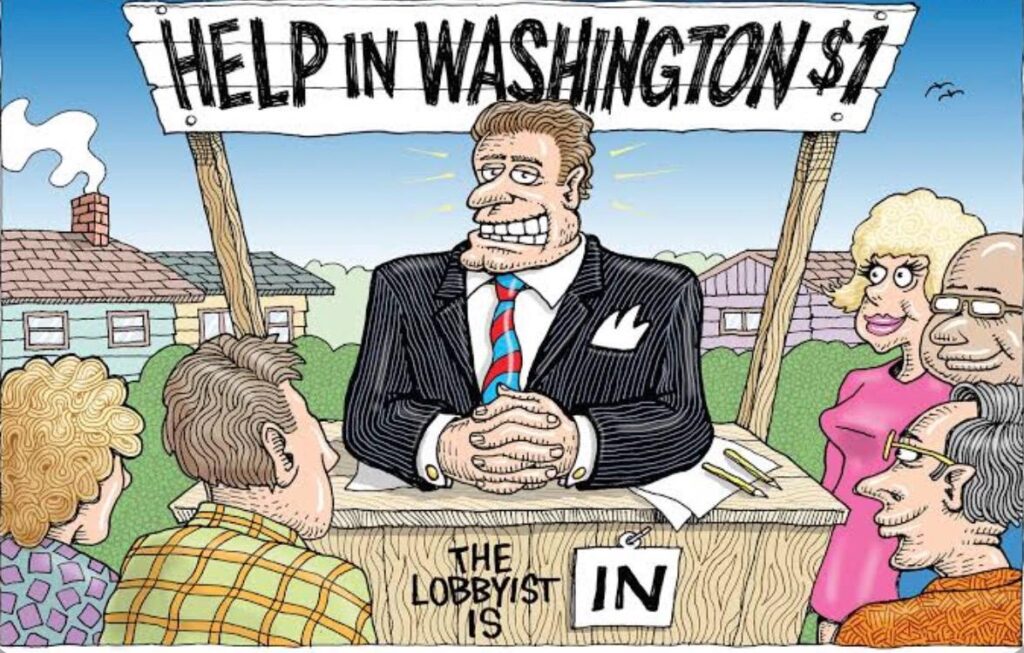
Campaign finance law is where the theory of democratic equality collides hardest with the reality of unequal resources, and no two democracies handle the collision the same way.
The United States. The American system was reshaped by a single Supreme Court decision. In Citizens United v. FEC (2010), the Court held that corporate and union spending on independent political communications is a form of protected speech under the First Amendment, and that the government cannot cap it. The ruling did not legalize direct corporate contributions to candidates, which remain restricted, but it opened the door to unlimited independent expenditures through Super PACs. It is widely credited with the explosion of what critics call dark money, spending routed through nonprofit groups that are not required to disclose their donors.
The scale that followed has become almost impossible to overstate. Federal lobbying spending crossed five billion dollars for the first time in 2025, reaching roughly $5.08 billion according to an OpenSecrets analysis of disclosure filings, an eleven percent jump after adjusting for inflation and the largest single-year increase the organization has recorded. Healthcare alone accounted for a record $868 million as the industry navigated Medicaid cuts tied to the 2025 tax and spending package, while finance, insurance, and real estate interests spent $711 million. A separate Bloomberg Government analysis put total 2025 spending even higher, at $5.3 billion, and found that for the first time on record, external lobbying firms outspent in-house corporate government affairs teams.
The European Union. Brussels tells a parallel story, though the numbers are smaller and the rules are looser. The EU’s Transparency Register now lists close to fifteen thousand organizations, and researchers estimate total annual lobbying expenditure in the city at somewhere between €1.6 and €2.2 billion. Big Tech has become the fastest-growing spender there. A joint analysis by Corporate Europe Observatory and LobbyControl found that the digital industry now spends roughly €151 million annually lobbying EU institutions, a 34 percent rise since 2023, with the top ten spenders, Meta, Microsoft, Apple, Amazon, and Google among them, together accounting for about a third of that total. Much of that spending has coincided with pressure on the EU’s AI Act and its digital rulebook, with tech firms holding, on average, more than one lobbying meeting a day with Commission officials.
Within the EU, member states differ sharply. Germany runs a federal lobby register, implemented in 2022, covering both corporate and consultant lobbyists. Ireland enforces quarterly disclosure with real financial penalties for non-compliance. Malta and Bulgaria, by contrast, have almost no binding disclosure rules at all, illustrating how a single bloc can contain both some of the world’s more transparent systems and some of its weakest.
The United Kingdom. Britain regulates spending caps on political parties and candidates fairly tightly through the Electoral Commission, though enforcement gaps around digital campaigning and undeclared loans have produced repeated scandals, including questions raised over party financing during and after the Brexit referendum.
India. India offers the most dramatic recent example of a court intervening to reverse a funding system it viewed as corrosive to democracy. In 2017, the government introduced electoral bonds, anonymous bearer instruments that let individuals and companies donate to political parties without public disclosure. By the time the scheme reached the Supreme Court, more than half of all political party funding in India was flowing through it. In February 2024, a five-judge bench led by Chief Justice D.Y. Chandrachud struck the scheme down as unconstitutional, ruling that it violated citizens’ right to information under Article 19(1)(a) and effectively enabled a quid pro quo dynamic between corporate donors and the ruling party. Undeclared donors had purchased bonds worth roughly $1.99 billion by late 2023, and disclosed data later showed the largest single purchaser, a lottery company, bought bonds worth over a billion rupees, some of it within days of a federal enforcement raid on the firm.
Pakistan. Pakistan’s framework, governed by the Election Commission and the Elections Act 2017, imposes disclosure obligations on party funding and bans donations from foreign nationals and companies. In practice, enforcement has been slow and politically contested. A foreign funding case against a major political party dragged through the Election Commission and courts for roughly eight years before a final ruling, an illustration of a pattern common across developing democracies: the law on the books is often stronger than the law as practiced, and the gap between the two becomes its own source of political controversy.
China. China does not operate a campaign finance system in the Western sense, because it does not hold competitive multiparty elections at the national level. Influence there flows through a different but equally consequential channel: the Chinese Communist Party’s control over state-owned enterprises, its embedded party committees inside private companies, and a licensing and regulatory regime that can reshape or eliminate a company’s business model overnight, as seen in the 2020s crackdown on the technology and private tutoring sectors. Power in this system is concentrated in a single party apparatus rather than contested among lobbyists, but the underlying question, of who can direct state resources toward private benefit, remains strikingly similar.
Singapore. Singapore presents a hybrid model worth noting precisely because it does not fit neatly into either category. The state holds significant ownership stakes in major companies through Temasek Holdings and GIC, its sovereign investment arms, giving government a direct commercial stake in the economy’s performance. Combined with strict controls on media ownership and campaign spending, this has produced a system with low measured corruption by international indices but also very limited space for the kind of adversarial, disclosure-driven contestation seen in the US or EU model.
The Nordic countries. Norway, Sweden, Denmark, and Finland consistently rank among the world’s least corrupt nations on Transparency International’s Corruption Perceptions Index, a result researchers generally attribute to high press freedom, strong freedom of information laws, relatively flat income distribution, and a political culture with low tolerance for the appearance of impropriety rather than to an absence of lobbying itself. Sweden moved to tighten tax disclosure rules quickly after being named in the 2017 Paradise Papers leak, an example of a system where scandal translates into rapid legislative response rather than years of stalled reform.
Latin America. Latin America’s defining recent case is the Odebrecht scandal, discussed in more detail below, which showed how a single construction conglomerate’s bribery network could implicate presidents and senior officials across a dozen countries simultaneously, exposing weak procurement oversight as a regional, not merely national, vulnerability.
African democracies. Across African democracies, the picture is similarly mixed. South Africa’s Zondo Commission, also detailed below, produced one of the most thoroughly documented accounts anywhere in the world of how a small network can systematically redirect state resources, while countries like Ghana and Botswana have built comparatively stronger institutional safeguards and score notably better on regional governance indices, evidence that outcomes vary enormously even within a single continent.
The Lobbying Industry
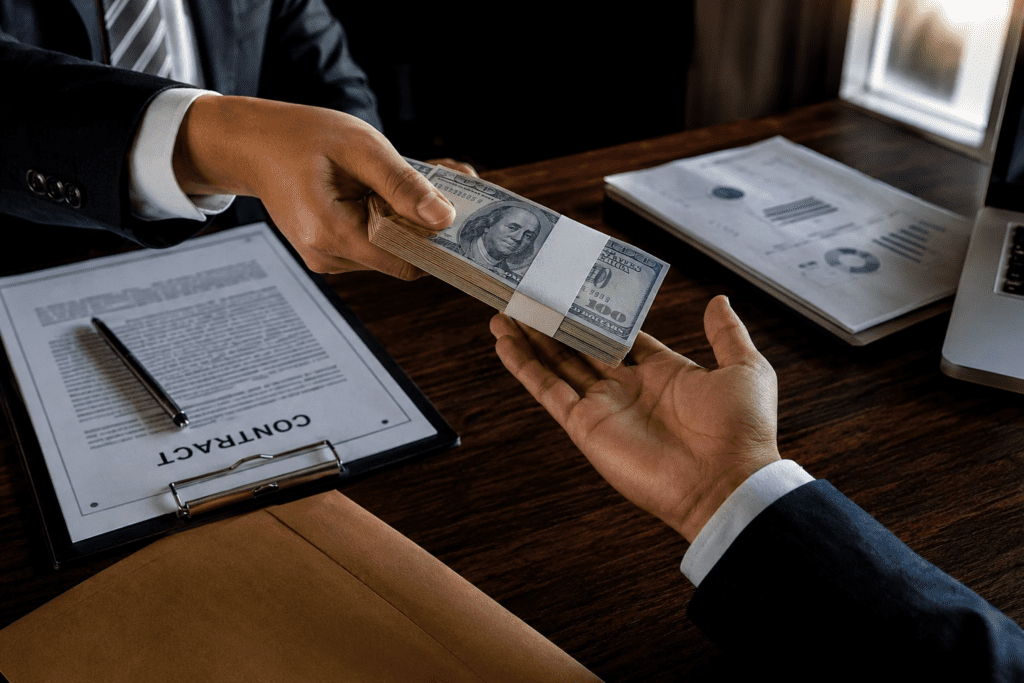
Lobbying is not new, and democracies permit it for a defensible reason: elected officials cannot be experts on everything, and organized interests, including unions, patient groups, and small businesses, have a legitimate claim to be heard. The First Amendment in the United States explicitly protects the right to petition government. The trouble is scale and asymmetry. A citizens’ group with a few volunteers and a pharmaceutical trade association with a nine-figure budget are technically exercising the same right, but they are not operating on the same playing field.
Pharmaceutical and health products companies were the single largest lobbying spenders in the first three quarters of 2025 in the United States, spending $341.3 million, ahead of electronics manufacturing at $226.3 million and securities and investment firms at $136.4 million. This is not evidence of a conspiracy. It is evidence of a rational response by companies operating in heavily regulated sectors, where the cost of a lobbyist is trivial compared to the cost of an unfavorable rule.
As one longtime Washington lobbying analyst observed, the biggest regulated industries simply spend more than unregulated ones, which is precisely why oil and gas companies pour so much money into federal lobbying: regulation is the terrain on which their profits are decided. The same logic explains why the tech sector’s EU lobbying spend has grown fastest in exactly the years the AI Act and Digital Markets Act were being negotiated.
Corporate Power, the Revolving Door, and Regulatory Capture
Multinational corporations do not just lobby individual bills. Over time, the more consequential work happens in shaping the underlying rules of entire regulatory systems, tax treaties, competition law, and increasingly, the frameworks now being written for artificial intelligence.
The clearest evidence of this sits in the disclosed lobbying registers themselves. Meta alone spent roughly €10 million lobbying the EU in the most recent reporting period, the highest of any single company, while Microsoft, Apple, and Amazon each spent around €7 million. The number of registered tech lobbyists with continuous access to the European Parliament, 437 by one recent count, now exceeds the number of sitting MEPs, a fact that says something about the relative density of corporate presence versus elected representation inside the institution writing the rules.
Asset management adds a less visible layer still. A small number of index fund giants, chiefly BlackRock, Vanguard, and State Street, now hold large minority stakes across most major publicly traded companies in the United States, a structure that academic researchers, including a widely cited 2017 study by Jan Fichtner, Eelke Heemskerk, and Javier Garcia-Bernardo, have described as concentrating quiet but real influence over corporate governance decisions, from executive pay to climate disclosure votes, without those firms ever appearing in a lobbying register at all.
If lobbying is the visible half of influence, the revolving door is the part that operates through relationships rather than dollar figures. Officials leave government and take jobs advising the industries they used to regulate. Executives leave industry and take senior regulatory posts. Neither transition is illegal in most jurisdictions, and neither is necessarily corrupt in any individual case. The problem is structural: an official who spends a career anticipating a future job in the industry they oversee, even subconsciously, is unlikely to regulate that industry as aggressively as one with no such prospect.
The case most often cited by EU transparency advocates is the appointment of Neelie Kroes, the former European Commissioner for digital policy, to an advisory role at Uber shortly after leaving office, a move that surfaced publicly through the leaked Uber Files investigation and drew sustained criticism over the appearance of policy access being monetized after the fact.
The pattern is old enough to have its own name in political science: regulatory capture, first theorized systematically by the economist George Stigler in the 1970s, who argued that regulatory agencies tend over time to be captured by the very industries they were created to police, simply because industry has more resources, more expertise, and more sustained interest in the outcome than diffuse taxpayers do.
International Financial Institutions
Beyond individual companies and lobbyists sits a layer of institutions whose influence over national policy is arguably harder to dislodge than any single corporation’s, precisely because their power is structural rather than transactional.
The IMF and World Bank. Created at Bretton Woods in 1944, the International Monetary Fund and World Bank were designed to stabilize the global economy and finance development. In practice, both institutions attach policy conditions to loans, historically through structural adjustment programs that required borrowing governments to cut public spending, privatize state assets, and liberalize trade in exchange for financing.
Critics, including former World Bank chief economist Joseph Stiglitz, have argued for decades that this conditionality framework has often prioritized fiscal orthodoxy over social outcomes, cutting health and education budgets in ways that deepened the very poverty the loans were meant to address. A 2018 academic review found that structural conditions in IMF programs have grown, not shrunk, since 2008, despite years of criticism, and researchers studying Sub-Saharan Africa have documented how conditionality has repeatedly constrained governments’ ability to prioritize their own domestic development goals over Fund-mandated reforms.
The Bank for International Settlements. Based in Basel and often described as the central bank for central banks, the BIS coordinates global banking regulation through standards like the Basel Accords, which set capital requirements that shape how much banks can lend, worldwide, without ever passing through a single national legislature.
Credit rating agencies. Moody’s, S&P, and Fitch occupy an unusual position: private companies whose judgments carry the practical force of law, since many pension funds and institutional investors are contractually barred from holding debt below a certain rating. A downgrade can raise a government’s borrowing costs overnight. In May 2025, Moody’s stripped the United States of its last remaining AAA sovereign credit rating, cutting it to Aa1 and citing the growth in government debt and interest payment burdens, following S&P’s 2011 downgrade and Fitch’s in 2023. The episode was a reminder that three privately owned firms retain the practical power to move global bond markets with a single press release, a form of influence with almost no equivalent democratic check.
Sovereign wealth funds. State-owned investment vehicles have grown into one of the largest pools of capital on earth, collectively managing roughly $13 to $14 trillion in assets as of 2025. Norway’s Government Pension Fund Global remains the largest single fund, holding stakes in more than seven thousand listed companies worldwide, around 1.5 percent of all global listed equity, while Saudi Arabia’s Public Investment Fund has scaled from under $200 billion to more than $1.1 trillion in less than a decade under the country’s Vision 2030 diversification strategy. These funds increasingly co-invest directly in strategically sensitive sectors, including semiconductors and artificial intelligence infrastructure, giving a small number of state treasuries direct ownership stakes in the technologies that will shape the next several decades.
Media, Platforms, and the Architecture of Attention
No account of global power is complete without the institutions that decide what the public actually sees, hears, and believes is worth debating in the first place.
Media ownership has consolidated dramatically over the past four decades in most major democracies, with a shrinking number of conglomerates controlling television networks, newspapers, and, increasingly, the digital platforms that distribute all of it. That concentration matters less for any single act of censorship than for its cumulative effect on agenda-setting, the well-documented phenomenon in which media coverage does not tell audiences what to think so much as what to think about, shaping which issues rise to public salience and which quietly disappear.
Digital platforms have added a second, less visible layer on top of ownership concentration: the recommendation algorithm. Unlike a newspaper editor whose choices are at least somewhat visible and accountable, the ranking systems that determine what appears in a billion news feeds are proprietary, largely unauditable by outsiders, and optimized primarily for engagement rather than accuracy or balance. Researchers studying platform design have repeatedly found that content triggering strong emotional reactions, including anger and outrage, tends to be amplified regardless of its truth value, a dynamic that shapes political discourse in ways no single editor or publisher ever could.
The 2018 Cambridge Analytica scandal remains the starkest illustration of how these two layers, platform data and political targeting, can combine. Tens of millions of Facebook users’ data were harvested without meaningful consent and used to build psychological profiles for political micro-targeting during the 2016 US election and the Brexit referendum campaign. The episode ultimately cost Meta a record $5 billion settlement with the US Federal Trade Commission in 2019, one of the largest privacy penalties ever imposed on a company, and it remains the reference case for regulators worldwide when discussing the intersection of platform power and electoral integrity.
Think Tanks and the Idea Factories
Between lobbyists and legislators sits a quieter layer of influence: the think tank, an institution that produces the research, framing, and talking points that make a policy position sound like independent expertise rather than special pleading.
The Brookings Institution, founded in 1916, and the Council on Foreign Relations, founded in 1921, remain among the most cited sources in American foreign and economic policy debates, generally regarded as center-left and centrist-establishment respectively, and both funded through a mix of foundation grants, corporate donations, and government contracts that are disclosed but not always closely scrutinized by the journalists who cite their work. The Heritage Foundation, founded in 1973, played a defining role in shaping the Reagan administration’s deregulatory agenda and has continued to produce detailed policy blueprints intended for direct legislative adoption by sympathetic administrations. Chatham House in London and the RAND Corporation in the United States occupy similar positions in defense, security, and international affairs debates, frequently briefing government officials directly.
None of this is illegitimate on its face. Expertise has to live somewhere, and think tanks often do genuinely rigorous work. The concern researchers raise is narrower: funding sources are not always transparent to the public consuming the research, and a think tank whose budget depends heavily on a single industry’s donations faces at least a structural incentive, whether or not any individual researcher acts on it, to produce findings that industry finds congenial.
Artificial Intelligence: The Next Governance Frontier
If the twentieth century’s defining influence battles were fought over oil, tobacco, and finance, the defining battle of this decade is being fought over artificial intelligence, and it is being fought by many of the same players using many of the same tools, only faster and with far more capital behind them.
Lobbying. The lobbying numbers alone signal the stakes. The EU’s digital industry now spends roughly €151 million a year lobbying Brussels, a 34 percent increase since 2023, driven substantially by pressure around the bloc’s AI Act. Much of that spending has coincided with a push to delay or soften implementation timelines, with Big Tech companies averaging more than one lobbying meeting a day with European Commission officials in the first half of 2025 alone.
Regulation and algorithmic governance. The regulatory landscape remains fragmented. The EU’s AI Act, the first comprehensive binding AI law of its kind, uses a risk-tiered approach, banning some uses outright and imposing heavy compliance obligations on high-risk systems. The United States has so far relied more heavily on sector-specific enforcement and state-level initiatives than on a single federal framework, while China has moved quickly on content and algorithm-specific rules aimed primarily at maintaining state control over information flows rather than at open competition or consumer protection in the Western sense.
Compute concentration. Perhaps the most consequential and least discussed dimension of AI power is physical: computing infrastructure itself. Five US hyperscalers, Amazon, Microsoft, Alphabet, Meta, and Oracle, are projected to spend roughly $660 to $700 billion on AI infrastructure in 2026 alone, nearly double 2025 levels, with Nvidia’s chips forming the backbone of almost all of it. This concentration of capital and hardware in a handful of companies means the practical capacity to train frontier AI systems is increasingly restricted to organizations that can marshal hundreds of billions of dollars, a barrier to entry with real implications for who gets to shape the technology’s trajectory, regardless of what any regulation eventually says on paper.
Open source versus proprietary AI. This compute concentration feeds directly into an ongoing debate over open-weight versus closed, proprietary AI models. Advocates of open models argue that broad access prevents a small number of firms from monopolizing a general-purpose technology; critics warn that widely available powerful models are harder to secure against misuse. Both camps, notably, are well represented among the same firms doing the heaviest lobbying, since the outcome of this debate will materially affect their competitive position.
AI safety, copyright, and deepfakes. Beyond market structure, AI raises governance questions with no close historical analogue. Ongoing copyright litigation against AI developers, brought by authors, news organizations, and artists, tests whether training models on copyrighted material without a license constitutes infringement, a question working through courts in multiple jurisdictions with no settled answer yet. Election officials in dozens of countries have flagged AI-generated deepfakes, synthetic audio, video, and images convincing enough to mislead voters, as a live threat to electoral integrity, a concern that has already prompted disclosure requirements for AI-generated political content in several US states and the EU. And a loose coalition of AI safety researchers, some inside the leading labs and some independent, continues to press for binding international coordination on the highest-risk model capabilities, an effort that so far has produced voluntary commitments and summit declarations rather than enforceable law.
Case Studies: What Documented Influence Actually Looks Like
The following episodes are included because each is documented, litigated, or resolved through courts, regulators, or official commissions of inquiry, not left as unverified allegation. Each is explained briefly here, with what happened, why it mattered, and what legal or policy lesson followed.
Citizens United v. FEC (2010). The US Supreme Court ruled that corporate and union independent political expenditures are protected speech, striking down spending caps and opening the door to Super PACs and dark money groups. The lasting lesson: courts, not just legislatures, can reshape the entire architecture of political finance in a single ruling, for better or worse depending on one’s view of the outcome.
Cambridge Analytica and Facebook (2018). Tens of millions of users’ data were harvested without consent and used for political micro-targeting around the 2016 US election and the Brexit vote, resulting in a record $5 billion FTC settlement with Meta in 2019. The lesson: platform-scale data collection combined with political advertising creates regulatory blind spots that existing privacy law was not built to address.
The Uber Files (2022). A leaked cache of internal documents showed Uber’s aggressive lobbying strategy in cities worldwide, including the hiring of former EU digital Commissioner Neelie Kroes as an advisor shortly after she left office. The lesson: the revolving door operates internationally, not just domestically, and disclosure rules rarely keep pace with cross-border corporate lobbying.
The 2008 Global Financial Crisis. Years of deregulation, much of it actively lobbied for by the banking and mortgage industry, preceded a collapse that required roughly $700 billion in Troubled Asset Relief Program funds to contain, with the institutions whose risk-taking caused the crisis receiving the bulk of the rescue. The lesson: deregulation driven by sustained industry lobbying can produce systemic risk whose costs fall disproportionately on the public, not the industry that lobbied for the rules.
The Panama Papers (2016) and Paradise Papers (2017). Leaked documents from offshore law firms exposed how politicians, executives, and public officials worldwide used anonymous shell companies to hide wealth and avoid taxes, triggering the resignation of Iceland’s prime minister and prompting Sweden to fast-track new tax disclosure rules. By 2019, the data had helped governments recover more than $1.2 billion in assets. The lesson: offshore financial secrecy functions as a parallel, largely invisible system of influence and wealth preservation that formal campaign finance law never touches.
LuxLeaks (2014). Journalists exposed secret tax rulings that allowed hundreds of multinational corporations to slash their tax bills through Luxembourg, implicating the country’s tax administration during the same period its prime minister, Jean-Claude Juncker, later became President of the European Commission. The lesson: small, well-positioned jurisdictions can exert outsized influence over global corporate tax policy through quiet administrative arrangements rather than open legislation.
Dieselgate (2015). Volkswagen was found to have installed software specifically designed to cheat emissions tests, deceiving regulators across multiple countries for years while the broader automobile industry lobbied against stricter testing regimes. The lesson: regulatory capture is not always about blocking new rules; sometimes it is about ensuring existing rules are never properly enforced.
Tobacco industry litigation (1990s–present). Decades of internal industry documents, eventually forced into public view through litigation including the 1998 Tobacco Master Settlement Agreement, revealed that manufacturers had known about smoking’s health risks for decades while funding research designed to manufacture public doubt. The lesson: industry-funded science can function as a lobbying tool in its own right, and litigation discovery, not initial regulation, was what ultimately forced disclosure.
Purdue Pharma and the opioid crisis (2007–2025). Purdue Pharma and its owners, the Sackler family, aggressively marketed OxyContin while downplaying its addiction risks, contributing to a crisis linked to roughly 900,000 overdose deaths in the United States since 1999. After years of litigation, a Supreme Court reversal of an earlier settlement, and a renegotiated bankruptcy plan, a $7.4 billion settlement became legally effective in 2025 and 2026, permanently barring the Sacklers from the addiction industry. The lesson: corporate accountability for a documented public health catastrophe can take close to two decades to resolve even after the underlying facts are established.
United States v. Microsoft (1998–2001). The Department of Justice sued Microsoft for illegally bundling its Internet Explorer browser with Windows to crush competition, resulting in a 2000 ruling that the company held an illegal monopoly. An appeals court later overturned the proposed breakup but upheld the finding of anticompetitive conduct, and the case settled with conduct restrictions in 2001. The lesson: behavioral remedies, not structural breakups, have historically been the more common outcome of major US tech antitrust cases, a precedent still shaping today’s Google litigation.
United States v. Google (2020–present). In August 2024, a federal court ruled that Google had illegally maintained its monopoly in online search through exclusive default agreements with device makers like Apple and Samsung, a company that reportedly pays Apple an estimated $20 billion annually for that placement. In September 2025, the court imposed behavioral remedies, banning exclusive default contracts for six years, while rejecting the Department of Justice’s request to force a breakup of Chrome, a ruling the DOJ has since appealed. The lesson: even a clear, adjudicated monopoly finding does not guarantee structural remedies, and appeals can extend final resolution for years.
The Odebrecht and Lava Jato scandal (2014–present). Brazilian construction giant Odebrecht ran a dedicated internal bribery division that paid more than $780 million in bribes across a dozen countries to secure roughly $3.34 billion in contracts, implicating multiple sitting and former presidents in Brazil, Peru, Ecuador, Panama, and beyond, and leading to the world-record $3.5 billion settlement Odebrecht and its subsidiary Braskem reached with US, Brazilian, and Swiss authorities in 2016. The lesson: a single company’s corruption can destabilize an entire region’s political class simultaneously, exposing how thin institutional safeguards can be even in countries with formally democratic systems.
South Africa’s state capture and the Zondo Commission (2016–2022). A four-year judicial inquiry documented in exhaustive detail how former President Jacob Zuma and the Gupta family systematically redirected state resources through key state-owned enterprises including Eskom and Transnet, with the Commission estimating roughly R57 billion in tainted state spending, more than 97 percent of it from just those two entities. The lesson: even a well-functioning constitutional order with a free press and independent judiciary can be substantially captured before its own institutions catch up, and formal findings do not automatically translate into prosecutions or recovered funds.
India’s electoral bonds ruling (2024). As detailed above, India’s Supreme Court struck down an anonymous political donation scheme that had come to account for more than half of all political party funding nationally, ruling it unconstitutional on right-to-information grounds. The lesson: judicial review remains one of the few mechanisms capable of unwinding an entire funding system after the fact, though only once sufficient evidence has accumulated to make the case.
What Defenders of the System Get Right
It would be dishonest to present only the case for concentrated influence without the case against overstating it.
Courts in most established democracies do constrain corporate behavior, sometimes decisively, as India’s Supreme Court and the US FTC both demonstrated. Independent media, however financially strained, continues to break stories that force regulatory action, as the Uber Files and Cambridge Analytica reporting both show. Competitive elections still produce genuine turnover, and public opinion still moves policy on issues from tobacco regulation to, more recently, parts of AI governance.
Anti-corruption institutions, freedom of information laws, and disclosure registers, imperfect as they are, exist precisely because past scandals forced their creation. The EU’s Transparency Register, whatever its enforcement gaps, did not exist twenty years ago. Neither did most modern lobbying disclosure law, nor South Africa’s Zondo Commission archive, nor India’s now-published electoral bond data.
The honest conclusion sits between two extremes. Governments have not been quietly replaced by corporations, financiers, or platforms. But neither do elected institutions operate free of concentrated private influence, and the gap between formal authority and actual agenda-setting power has widened, not narrowed, as lobbying spending, asset concentration, and digital platform reach have all grown faster than the disclosure and accountability systems meant to check them.
Where This Is Heading
The next battleground for this same dynamic is already visible. Artificial intelligence regulation is being shaped right now by the same firms it will govern, with tech lobbying spend in Brussels rising specifically around the AI Act’s implementation timeline, and hundreds of billions of dollars in compute infrastructure concentrating practical control over frontier AI development in a handful of companies regardless of what any statute eventually says. Central bank digital currencies will raise fresh questions about how much control states retain over monetary systems increasingly built by, or dependent on, private financial infrastructure. And the same asymmetry that shaped twentieth-century lobbying, resources versus representation, is likely to define whichever institutions end up writing the rules for autonomous systems, digital identity, and algorithmic governance over the next three decades.
Conclusion
So who really rules the world? No single actor does. Power today is distributed unevenly across elected governments, courts, corporations, financial institutions, technology platforms, media organizations, and international bodies, and the balance shifts by country and by policy area. What determines whether that balance serves the public or subverts it is not the existence of lobbying or corporate influence, both of which are permanent features of complex societies. It is whether transparency laws, independent courts, a free press, and functioning elections remain strong enough to keep concentrated interests answerable to everyone else. Where those institutions hold, as they did in India’s electoral bonds case and South Africa’s Zondo Commission, influence gets checked, however slowly. Where they weaken, it doesn’t.
Selected Sources
Lobbying and campaign finance: OpenSecrets (2026), Lobbying firms took in a record $5 billion in 2025; Bloomberg Government (2026), annual lobbying disclosure analysis; EU Transparency Register (2025); Corporate Europe Observatory & LobbyControl (2025), Revealed: Tech industry now spending record €151 million on lobbying the EU; Transparency International EU (2024), Lobby Transparency Across the EU.
Courts and elections: Citizens United v. Federal Election Commission, 558 U.S. 310 (2010); Association for Democratic Reforms v. Union of India (2024), Supreme Court of India; Al Jazeera (2024), India’s Supreme Court scraps electoral bonds; Association for Democratic Reforms (2024), Democratizing Elections.
Corporate power and antitrust: United States v. Microsoft Corp., 253 F.3d 34 (D.C. Cir. 2001); United States et al. v. Google LLC (D.D.C. 2024, remedies 2025); Fichtner, J., Heemskerk, E. M., & Garcia-Bernardo, J. (2017), Hidden power of the Big Three?, Business and Politics.
Financial institutions: Stiglitz, J. (2002), Globalization and Its Discontents; Bretton Woods Project (2019), What are the main criticisms of the World Bank and the IMF?; Moody’s Ratings (2025), 2025 United States Sovereign Rating Action; Global SWF and SWF Institute (2025–2026), sovereign wealth fund rankings.
Case studies: International Consortium of Investigative Journalists (2016, 2017), Panama Papers and Paradise Papers investigations; Transparency International (2020), Panama Papers: Four Years On; ICIJ (2019), Bribery Division: What is Odebrecht?; Judicial Commission of Inquiry into State Capture (Zondo Commission), Final Reports, Parts 1–6 (2022); Connecticut Office of the Attorney General (2025), Purdue Pharma settlement statements; U.S. Federal Trade Commission (2019), Facebook settlement order.
Historical background: Stigler, G. J. (1971), The Theory of Economic Regulation, Bell Journal of Economics; Nye, J. S. (2004), Soft Power: The Means to Success in World Politics; Chandler, A. D. (1977), The Visible Hand; standard institutional histories of the Bretton Woods system and the Progressive Era antitrust movement.
Artificial intelligence: EU Artificial Intelligence Act (Regulation 2024/1689); Futurum Group (2026), AI Capex 2026: The $690B Infrastructure Sprint; Center for a New American Security (2026), American AI Companies Can’t Get Enough Chips.
Note on sourcing: this piece draws on named news organizations, court and commission records, government and regulatory filings, and peer-reviewed or institutionally published research current as of mid-2026. Figures tied to fast-moving areas, lobbying spend, AI infrastructure investment, and sovereign wealth fund assets in particular, change quickly and should be treated as snapshots rather than fixed totals.